
Rachel's Reflections: A Message from Our Executive Director
Saying It Again: A Rosh Hashanah Reflection on Repetition and Women's Voices
September 2026
A few years ago, my husband was deep in one of his rabbit holes, this one on rock climbing. He is a history major, a former organized crime lawyer, an outdoor sports enthusiast, and a self-confessed Jewish podcast fiend, and every one of those interests tends to be saturated with male voices telling stories from male perspectives. I've learned a great deal from his constant search for new authors and thinkers on all of these topics. But that year, I asked him a simple, genuinely curious question: had he read any books about female rock climbers? I knew there were many. He thought about it for a minute and admitted he hadn't. We went over to his bookshelf together to check. Of about thirty-five books, one was written by a woman.
Since then, my husband and my son have made a point of seeking out women's voices within their own interest areas: narrative nonfiction about historical battles, wars, and shipwrecks; memoirs by athletes and musicians; biographies of elite skiers, rowers, and mountain bikers. It has mattered for my husband to hear, not only from me, someone who advocates for gender equity professionally, but from a pro skier he genuinely admires, that women athletes still face discrimination, pay gaps, and silencing even at the highest levels of their sport. That understanding is now part of how he sees the world.
Most recently, he picked up Fierce Country: The Untold Story of Three Women Who Ignited America's Love for the Wild, the newest book by Heather Hansman, an author he now follows closely. I found the epigraph almost startling in its honesty: a line from Simone de Beauvoir, "I hesitated a long time before writing a book on women. The subject is irritating, especially for women – and it is not new." De Beauvoir wrote that in 1949. Reading it on the opening page of a book published this year landed as both an indictment and a confession: nearly eighty years later, we are still saying it.
Why is it irritating to keep saying the same thing: that women's experiences are distinct, and that they deserve space in our literature, our history, our education? And when I say women, I mean all women, including trans women, whose stories and contributions have too often been pushed even further to the margins. The same is true for nonbinary people and others whose experiences complicate the gendered narratives we have inherited.
I'd argue that as Jews, we already know why repetition matters, because our entire tradition is built on exactly this kind of return. The glue of our peoplehood is the retelling of the same texts, the same values, the same stories, year after year. We are entering the holiest days of our calendar in a few weeks, and when we do, we will stand and recite the same Vidui, confessing the same sins, in the same words, often to the same tunes, frequently surrounded by the same people we confessed alongside last year. We don't retire from that confession after one good year, because we know ourselves. The resolve fades. The chest-pounding gets further away in memory. We need to be reminded again, and again, and again.
And if you understand these Days of Awe as more sociological than theological, less about keeping promises to God and more about what Durkheim called “collective effervescence,” the ritual that binds a community together, then the parallel to how we must lift women's voices only gets stronger.
When a woman speaks alone about her own experience, she is easy to dismiss, minimize, or explain away. We see this occur far too frequently in our news cycles and on our national political stage. But when that same truth is spoken again, and again, in unison, held by a community that shows up to hear it and repeat it back, something changes. It stops being one woman's complaint and becomes a shared, validated reality, one that deserves to be heard and honored year after year.
I feel this most in the parashah of Zelophehad's daughters – Mahlah, Noah, Hoglah, Milcah, and Tirzah – a portion actually named for Pinchas, not for them. Of the fifty-four weekly Torah portions in our annual cycle, five are named for men: Noach, Yitro, Korach, Balak, and Pinchas. Exactly one, Chayei Sarah, honors a woman.
It is exhausting to be the ones who have to keep pointing this out, to keep pulling women's stories out from under the men's names attached to them. It has been this way for generations, and it will likely be this way for a while longer. That's precisely why the pointing-out cannot be a one-time act. It has to be a practice, repeated on purpose, the way we repeat everything that matters most to us as Jews.
So as we move deeper into Elul, here is what I'd ask: look at your own bookshelf, your syllabus, your board roster, your pulpit calendar, the way I looked at my husband's. Notice whose names are missing, and whose stories get filed under someone else's portion. Then do something Jewish about it, not once, but as a practice you return to every year.
Make room for women, cis and trans, and for nonbinary people and other voices too often pushed to the margins. Seek out their stories. Listen when they speak. And when they are, once again, saying what they've already said, help carry those truths forward: we were there too, our stories matter, and the more fully we're told, the less irritating and the more sacred the retelling becomes.
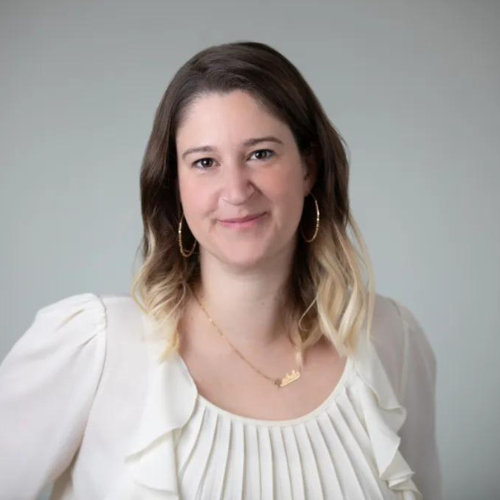

Rachel Gildiner
Executive Director
SRE Network